Uposatha days


The calendar shows the Uposatha days as the suttas count them — the 14th, 15th and 8th lunar days of each half-month, six a month — with the exact moments in your time zone and place. It is a page of its own, part of the app; below is the real page, a live demo (scroll inside it, or open it in a new window). This page explains how to read it and what its settings do. The suttas themselves are on the calendar page (the slideshow "From the suttas" and its "Show all" list).
Reading the calendar
Three views. "By dates" (the first one) is a table of dates with the beginning and the end of each Uposatha and the Moon; "Uposatha days" is a list by months and weeks; "Calendar" is an ordinary month with the days marked. The card "Today" above them gives the Moon now: its phase, the lit part, its age since the new moon, and the lunar day with the moments it began and ends.
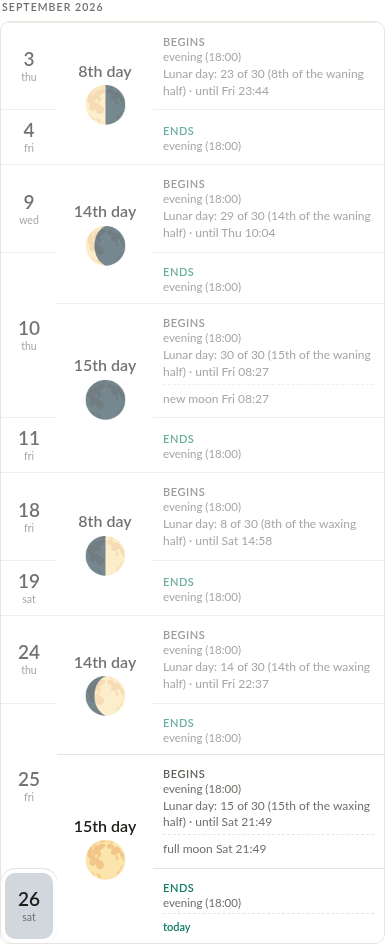
Dates. A day in the suttas begins in the evening ("night and day", AN 3.70), so an Uposatha is dated by the evening it begins and lasts through the night and the next day. In the month calendar the evening date has a ring; the next date, the day of that Uposatha, has a dashed ring. When the 14th and the 15th follow each other, the three dates read 14 · 14–15 · 15: on the middle one the 14th is still going in the day and the 15th begins in the evening. The 15th is filled; the 8th and the 14th are rings.
The lines of a date. Begins — the evening; Observed — the night and the day it covers; Lunar day — the real lunar day of that Uposatha, for checking. Real lunar days are numbered 1 to 30 through the month (the Moon gains 12° on the Sun each day); the suttas name the days by their number within a half, so the 8th day of the waning half is the 23rd of the month and the 14th of the waning half the 29th. A lunar day changes at an exact moment, not at midnight, and lasts 19 to 26 hours, so against the calendar dates a number sometimes appears twice or is skipped; the calendar reads this from the real Moon and says so in a note under the date. The lunar day is read at the dawn that follows the evening, because the daytime of the Uposatha lies there.
The full and the new moon are moments and often fall on the next date; they are marked on the date they really fall on, with the time.
Dates can differ by a day. The moments come from an astronomical model, accurate to about a minute. Thai, Sri Lankan and Burmese communities calculate their calendars by tradition and can differ from these dates by a day; if you keep the Uposatha with a particular community, follow its calendar.
Settings
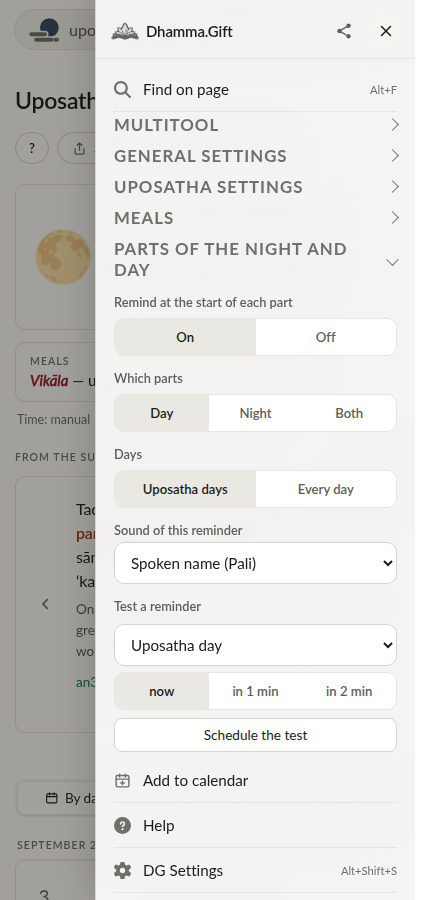
Open the menu ☰. The settings are in folding groups — "General settings" (language, theme, font size), "Uposatha settings", "Meals" and "Parts of the night and day"; what you leave open is remembered. The link "change" under the card "Today" and "Set a place" by the heading "Structure of the night and day" lead straight to the place.
Time zone and hemisphere. The moments are shown in your time zone; the hemisphere decides which side of the Moon is lit in the pictures. When a place is set, both are taken from it and the manual fields are hidden.
Place. With your location (or a city typed in the field) the evening is the real sunset and the sun's times are shown; without it the evening is taken at 18:00 and the day parts at 06:00 – 18:00, marked with an asterisk. The location is used only in your browser, rounded to about a kilometre, and is not sent anywhere.
Week starts on. Monday or Sunday; until you choose, Monday in Russian and Sunday in English.
By the suttas. On — the Uposatha as in the suttas, six days a month, counted from the evening. Off — the modern scheme: four days a month, the dates of the new moon, the first quarter, the full moon and the last quarter (the label turns burgundy so that it is not mistaken).
Details. Off — every date in one short line.
Twilight. "Dawn and dusk" lets you count the day from sunrise and sunset, or from civil, nautical or astronomical twilight. It needs a place.
Reminders. Switch on "Remind me", choose when — from "when it begins" up to two days before — and for which days: by default the 8th and the 14th; the 15th can be added. The reminder for the 14th says that there are two Uposatha days, the 14th and the 15th. On the site a reminder comes only while the page is open or running in the background of your device (the sound you choose plays then too); Safari and iPhone can hold it back. In the Android app the reminders are set on the device itself and arrive with the app closed, each with its own sound; the iOS app is planned. Or add the days to your phone's calendar.
Your own calendar. The button "Add to calendar" (and the same row in the menu) opens the options:
- Apple opens the subscription in Apple Calendar (also other apps that accept a
webcallink); Google opens the "add by URL" form in Google Calendar; Copy link gives the link for any other program. A subscription covers the coming year and renews itself. Nothing is stored on our side — the link carries your choices (place, scheme, reminder time), so the same link gives the same calendar to whoever opens it. Apple Calendar keeps the alarms from the feed; Google Calendar ignores them for subscribed calendars and uses its own default notifications. - Download .ics file adds the next 12 months once, with alarms, to any calendar. It does not update afterwards.
Share copies the link to the page or opens the share sheet of your device.
Meals
The card "Meals" shows the time for food (dawn to midday) or vikāla, "the wrong time" (midday to the next dawn; Pc 37). Midday is counted by the sun, the middle of the day, or the clock. The bell in the corner of the card switches on reminders for the end (default sound: the Vinaya definition of vikāla, read aloud) and for the beginning of the time for food.
Structure of the night and day
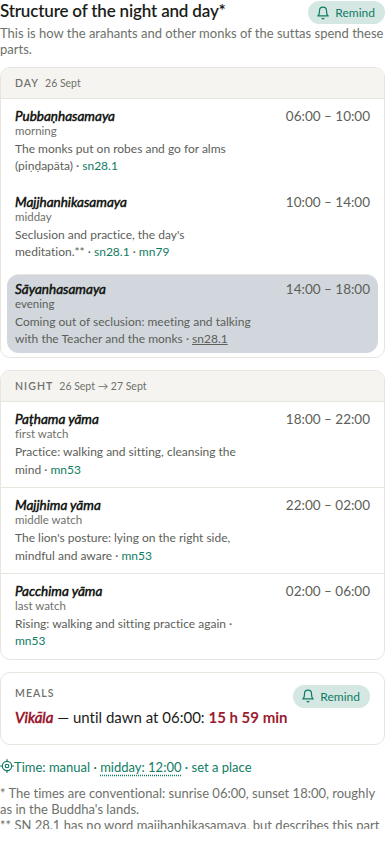
The suttas divide the day into three parts — pubbaṇhasamaya (morning), majjhanhikasamaya (midday) and sāyanhasamaya (evening) — and the night into three parts — paṭhama yāma, majjhima yāma and pacchima yāma (MN 53; AN 8.9; Ud 1.1). The page cuts the time from sunrise to sunset into three equal parts, and from sunset to sunrise likewise, for your place and today's date, and marks the part that is going on now. This is conventional, for illustration: the suttas give no clock times, and the parts are longer or shorter with the season.
What is written by each part — alms in the morning, seclusion at midday, meeting in the evening; walking and sitting, the lion's posture, rising — is how the arahants and other monks of the suttas spend it (SN 28.1, MN 53): a picture from the suttas, not a rule; a layperson is not required to do so. The word majjhanhikasamaya itself is in MN 79 ("the sun at midday"); SN 28.1 does not use it, but describes that part of the day: after the meal, the day's meditation, coming out in the evening.
Reminders of the parts. The bell by the heading sets a reminder at the start of each part: by default only the day parts, on Uposatha days, with the part's name read aloud in Pali. The night parts, every day and the sound are in the menu.
Other moon tools
The beginning and the end of a lunar day and the phases of the Moon are astronomical data. To check them or to see them another way:
- Website: Time and Date: Moon Phases
- Apps: Daff Moon Phase (Android) or MOON (iOS)
- For developers: lunarphase-js; this calendar itself uses astronomy-engine.